My son is studying to be confirmed by his bishop at the end of the month. He is a youngest of a group of young confirmands, and I am proud of them all.
Of course, they don't always talk the way we might think they should talk about God. But conversation with them about God is always enjoyable and often quite rewarding as I learn more about my faith from them.
One of my young confirmands had a hard time grasping the meaning of being gifted with the Holy Ghost at his baptism. He was probably four or five and he asked: "Is the Holy Ghost heavy? Will I still be able to jump if I get the Holy Ghost?"
Of course, those questions are awfully good at reminding me of how very little I know. My son helped me in that category the other night as we were talking our way through the Apostle's Creed.
We were talking of Jesus being born of the Virgin Mary (after some discussion of the theotokos, we had to discuss the two natures of Jesus so that he could understand how Mary did not, indeed, exist before God) and of how he grew up into a little boy, like my son, and how he must have played and fallen down and done so many things that boys do.
As we were discussing how very real and human Jesus was in the terms that my son tends to understand, he popped off with:
"Dad, I just really have a problem with that guy."
Of course, my eyebrows raised and I asked which "guy" he was referring to.
"Jesus, Dad, I just really have a problem with that guy."
"And what problem do you have, son?"
"Well," he began, in his five-year-old voice, "How can he know everything???"
I decided that that was a very good question indeed and saved the rest of the discussion for a later time when, perhaps, my mind might be as sharp, as full of wonder, and as inquisitive as my son's and his fellow confirmands'.
Sunday, October 15, 2006


Thursday, September 14, 2006
Aidan's First Day of School


My son has attended school since he was a newborn, but this is the first time that he's actually a student at St. Andrew's Academy! Not a bad start--only had to see the headmaster once....
Saturday, September 02, 2006
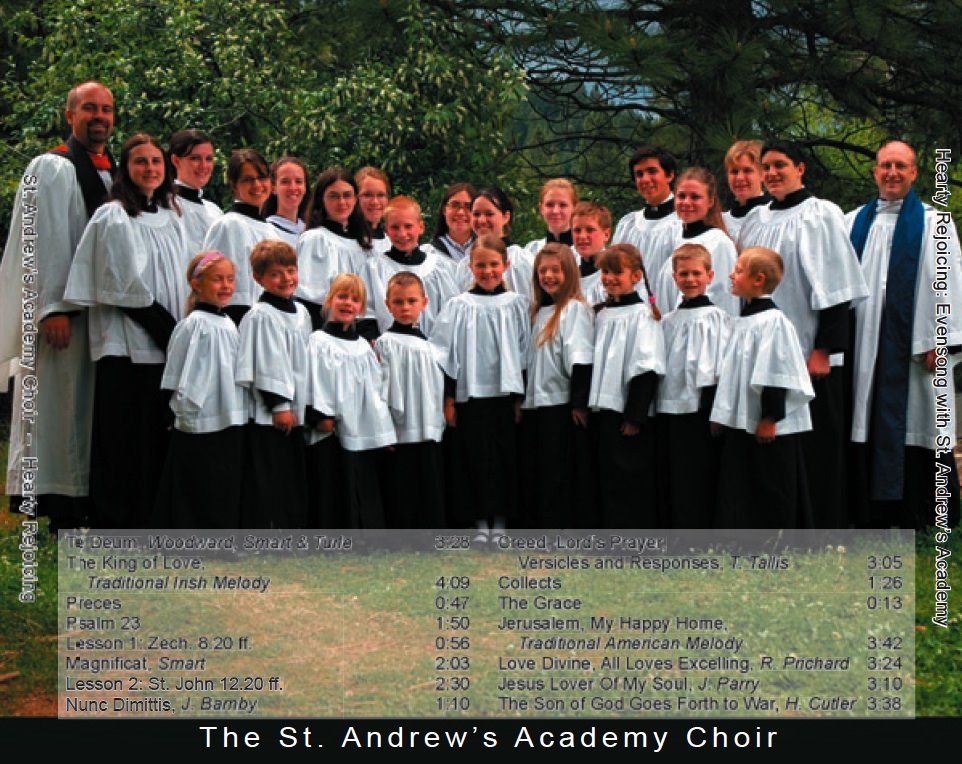
St. Andrew's Academy Choir Chanting the Te Deum

In place of a thoughtful post, I give you the Te Deum--much more thoughtful than anything I could come up with....
This is a cut off the St. Andrew's CD for Spring, 2006 (cover of the CD above).
Photo Sharing - Upload Video - Video Sharing
Sunday, July 09, 2006
The Doctrine of the Real Presence of Christ in the Holy Eucharist from the Anglican perspective
A friend of mine, Father Derrick Hassert, has written the following on the the doctrine mentioned in the title. Any thoughts, comments, questions, snide remarks?
As Anglicans I believe we must first go to the Scriptures, where we are told by St. Paul that the “. . .Lord Jesus, the same night in which He was betrayed, took bread; and when He had given thanks, He broke it and said, ‘Take, eat; this is My body which is broken for you: this do in remembrance of Me.’ In the same manner also He took the cup when He had supped, saying, ‘This cup is the new testament in My blood: this do ye, as oft as ye drink it, in remembrance of Me.’ For as often as ye eat this bread and drink this cup, ye do show the Lord's death until He come. Therefore whosoever shall eat this bread and drink this cup of the Lord unworthily, shall be guilty of the body and blood of the Lord. But let a man examine himself, and then let him eat of that bread and drink of that cup. For he that eateth and drinketh unworthily, eateth and drinketh damnation to himself, not discerning the Lord's body” (1 Cor 11: 23-29).
Similarly, St. Paul declares to us that “The cup of blessing which we bless: is it not the communion of the blood of Christ? The bread which we break: is it not the communion of the body of Christ? For we, being many, are one bread and one body, for we are all partakers of that one Bread” (1 Cor 10: 16-17). The writings of the Church Fathers, especially the Apostolic Fathers, declare likewise without any great philosophical speculation. The truth of Christ’s words, and the words of St. Paul, are accepted through faith.
When we turn to the formularies of classical Anglicanism (the 1549-1928 Prayer Books, the Articles, and the homilies) what are we told about the Eucharist? We are told that it is an “outward and visible sign of an inward and spiritual grace” the outward part being bread and wine and the inward part being Christ’s Body and Blood. The Articles declare likewise that the “The Body of Christ is given, taken, and eaten, in the Supper, only after an heavenly and spiritual manner.” In the homilies we read of “the due receiving of the blessed Body and Blood of our Saviour Christ under the form of bread and wine.”
Here, in the classical Anglican documents, we have a very Scriptural teaching which conforms as well to the teachings of the Church Fathers. Some wish to press beyond these points of agreement and engage in all manner of scholastic inquiry…. Some will ask the manner of Christ’s Presence in the Sacrament? Is it bodily, physical, carnal, corporal, localized?
Though some may hold to various viewpoints that are more specific than that outlined above by Father Hassert, many would argue that they are not to be pushed on the Church for belief because they cannot be proved by and from Scripture. Many would also argue that the basic Scriptural basis of Anglicanism is also one of its greatest strengths.
As Anglicans I believe we must first go to the Scriptures, where we are told by St. Paul that the “. . .Lord Jesus, the same night in which He was betrayed, took bread; and when He had given thanks, He broke it and said, ‘Take, eat; this is My body which is broken for you: this do in remembrance of Me.’ In the same manner also He took the cup when He had supped, saying, ‘This cup is the new testament in My blood: this do ye, as oft as ye drink it, in remembrance of Me.’ For as often as ye eat this bread and drink this cup, ye do show the Lord's death until He come. Therefore whosoever shall eat this bread and drink this cup of the Lord unworthily, shall be guilty of the body and blood of the Lord. But let a man examine himself, and then let him eat of that bread and drink of that cup. For he that eateth and drinketh unworthily, eateth and drinketh damnation to himself, not discerning the Lord's body” (1 Cor 11: 23-29).
Similarly, St. Paul declares to us that “The cup of blessing which we bless: is it not the communion of the blood of Christ? The bread which we break: is it not the communion of the body of Christ? For we, being many, are one bread and one body, for we are all partakers of that one Bread” (1 Cor 10: 16-17). The writings of the Church Fathers, especially the Apostolic Fathers, declare likewise without any great philosophical speculation. The truth of Christ’s words, and the words of St. Paul, are accepted through faith.
When we turn to the formularies of classical Anglicanism (the 1549-1928 Prayer Books, the Articles, and the homilies) what are we told about the Eucharist? We are told that it is an “outward and visible sign of an inward and spiritual grace” the outward part being bread and wine and the inward part being Christ’s Body and Blood. The Articles declare likewise that the “The Body of Christ is given, taken, and eaten, in the Supper, only after an heavenly and spiritual manner.” In the homilies we read of “the due receiving of the blessed Body and Blood of our Saviour Christ under the form of bread and wine.”
Here, in the classical Anglican documents, we have a very Scriptural teaching which conforms as well to the teachings of the Church Fathers. Some wish to press beyond these points of agreement and engage in all manner of scholastic inquiry…. Some will ask the manner of Christ’s Presence in the Sacrament? Is it bodily, physical, carnal, corporal, localized?
Though some may hold to various viewpoints that are more specific than that outlined above by Father Hassert, many would argue that they are not to be pushed on the Church for belief because they cannot be proved by and from Scripture. Many would also argue that the basic Scriptural basis of Anglicanism is also one of its greatest strengths.
Tuesday, July 04, 2006
St. Andrew's Academy is Hiring!
St. Andrew’s Academy is looking for teachers for the 2006-2007 school year. St. Andrew’s is a K-12, Anglican, classically oriented, college preparatory, parochial school in Lake Almanor, California. We are currently looking for individuals who want to make a difference in students’ lives and the culture at large. Our teachers typically work across a variety of grade levels, but one of our most pressing needs is for grammar school instructors—ones that can provide a stable character influence and set an example of excellence for our youngest students.
Successful applicants do not need teaching experience, but will need to learn and apply instruction. If you have teaching experience, we won’t hold this against you too much. Confidence, honesty, and self-motivation will also be key. Because of the classical emphasis, experience in Latin and New Testament Greek are definite benefits.
The Lake Almanor/Lassen National park area is situated at the northernmost end of the Sierra-Nevada Range and at the southernmost end of the Cascade Range. The environment is alpine with pleasant summers and snowy winters, and the natural landscape is quite spectacular. Recreational opportunities such as fishing, hunting, hiking, kayaking, and cross-country and downhill skiing are plentiful, and the local communities are rural. The school is located about 1.5 hours northeast of Chico, California, and 2 hours northwest of Reno, Nevada.
The motto of St. Andrew’s is “Oratio, Studium, Labor,” which translated is “Prayer, Study, Work,” for this reflects our school’s priorities. Everyday begins and ends with traditional sung prayers, and our students know that our worship is the most important part of the day. Of course, our academic expectations of students are demanding, but in the context of the Christian life, this is viewed as an opportunity to glorify God. We also ask the students to take ownership of their school by helping to maintain the facilities and to work in other ways to serve their neighbors. Involvement at St. Andrew’s is not separable from community life; we constantly seek to encourage and build our community. This is specially important for the faculty as they often lead in this task. As a group of colleagues, we seek to pursue Truth, Goodness, and Beauty, and daily invite our students to join us. This is our educational task. Being involved with St. Andrew’s is rarely easy, but always adventurous and rewarding.
Applicants must understand that St. Andrew’s has always been a work of faith, and as such, there is some risk involved. This is therefore a step of faith for all our staff, but please understand that God has always met our needs—and the needs of our faculty—and the ethos of the school would not be the same without constant dependence on Him.
If this mission intrigues you, please give us a call at 530-596-3343 and ask to speak to Father Brian Foos, Headmaster, or Mr. Kent Bartel, Assistant Headmaster, or drop us an email at. If you have a chance, please email your Curriculum Vitae (academic resume) to the same address.
Successful applicants do not need teaching experience, but will need to learn and apply instruction. If you have teaching experience, we won’t hold this against you too much. Confidence, honesty, and self-motivation will also be key. Because of the classical emphasis, experience in Latin and New Testament Greek are definite benefits.
The Lake Almanor/Lassen National park area is situated at the northernmost end of the Sierra-Nevada Range and at the southernmost end of the Cascade Range. The environment is alpine with pleasant summers and snowy winters, and the natural landscape is quite spectacular. Recreational opportunities such as fishing, hunting, hiking, kayaking, and cross-country and downhill skiing are plentiful, and the local communities are rural. The school is located about 1.5 hours northeast of Chico, California, and 2 hours northwest of Reno, Nevada.
The motto of St. Andrew’s is “Oratio, Studium, Labor,” which translated is “Prayer, Study, Work,” for this reflects our school’s priorities. Everyday begins and ends with traditional sung prayers, and our students know that our worship is the most important part of the day. Of course, our academic expectations of students are demanding, but in the context of the Christian life, this is viewed as an opportunity to glorify God. We also ask the students to take ownership of their school by helping to maintain the facilities and to work in other ways to serve their neighbors. Involvement at St. Andrew’s is not separable from community life; we constantly seek to encourage and build our community. This is specially important for the faculty as they often lead in this task. As a group of colleagues, we seek to pursue Truth, Goodness, and Beauty, and daily invite our students to join us. This is our educational task. Being involved with St. Andrew’s is rarely easy, but always adventurous and rewarding.
Applicants must understand that St. Andrew’s has always been a work of faith, and as such, there is some risk involved. This is therefore a step of faith for all our staff, but please understand that God has always met our needs—and the needs of our faculty—and the ethos of the school would not be the same without constant dependence on Him.
If this mission intrigues you, please give us a call at 530-596-3343 and ask to speak to Father Brian Foos, Headmaster, or Mr. Kent Bartel, Assistant Headmaster, or drop us an email at
Tuesday, June 27, 2006
Provincial Synod, 2006
I suppose a rather boring post to get back into the blogging groove. I've never posted tons, but my goal was to keep a post up about once a week. Obviously, I've failed. Perhaps this will help get me back on track.
We--my wife and I--just returned from a trip to synod in Indiana with two other faculty of St. Andrew's Academy and 11 students (and my infant daughter Elizabeth). Most of us comprise the St. Andrew's Academy Choir and we sang five services in the space of three days there in Indiana--and that was after touring Chicago for a night and a day.
We are so thankful for the wonderful reception the representatives of Churches across the states gave us. Everyone was so kind and generous. They even bought 70+ CD's of our Choir singing Evensong and some hymns.
In contrast to what we heard and saw going on at the ECUSA General Council, our Provincial Synod was an absolute blessing to all who attended, I believe, and our disagreements centered more on whether or not one liked the hymn sang at morning prayer. Thanks be to God for orthodox bishops and leading clergy.
We--my wife and I--just returned from a trip to synod in Indiana with two other faculty of St. Andrew's Academy and 11 students (and my infant daughter Elizabeth). Most of us comprise the St. Andrew's Academy Choir and we sang five services in the space of three days there in Indiana--and that was after touring Chicago for a night and a day.
We are so thankful for the wonderful reception the representatives of Churches across the states gave us. Everyone was so kind and generous. They even bought 70+ CD's of our Choir singing Evensong and some hymns.
In contrast to what we heard and saw going on at the ECUSA General Council, our Provincial Synod was an absolute blessing to all who attended, I believe, and our disagreements centered more on whether or not one liked the hymn sang at morning prayer. Thanks be to God for orthodox bishops and leading clergy.
Saturday, April 01, 2006
A Related Quote (to the post below)...on Church discipline
"‘In the Primitive Church there was a godly discipline, that, at the beginning of Lent, such persons as stood convicted of notorious sin were put to open penance . . . until the said discipline may be restored again, which is much to be wished.’ – Introduction to the Commination.
Yet Church Discipline was, even throughout the eighteenth century, a much greater reality than at the present day. Excommunications and presentments were still in force, and the commutation of penance was a matter of grave and careful consideration even by so strong a Protestant as William III.
Wordsworth has told us that one of his earliest recollections (about 1777) was seeing a woman doing penance in a white sheet: this was called ‘solemn penance’" (Percy Dearmer's Parson's Handbook, emphasis mine).
Note: The Commination is a penetential service appointed for Ash Wednesday, to be found in the 1662 Book of Common Prayer.
Yet Church Discipline was, even throughout the eighteenth century, a much greater reality than at the present day. Excommunications and presentments were still in force, and the commutation of penance was a matter of grave and careful consideration even by so strong a Protestant as William III.
Wordsworth has told us that one of his earliest recollections (about 1777) was seeing a woman doing penance in a white sheet: this was called ‘solemn penance’" (Percy Dearmer's Parson's Handbook, emphasis mine).
Note: The Commination is a penetential service appointed for Ash Wednesday, to be found in the 1662 Book of Common Prayer.
Monday, March 27, 2006
American Churchmanship
A bishop once said to me: "The problem in America is not that we have a poor ecclesiology, but that we have no ecclesiology."
That point has been brought home to me on more than one occasion. We don't seem to have a category in American Churchmanship for "The Church has spoken"--at least not unless we like what she says, in which case we say, "great, but I was thinking that already." Without the authority of the Church in our Christian culture, it becomes a veritable free-for-all in terms of Biblical interpretation and what behavior ought to be seen from a Christian. Yes, most everyone tends to agree that the moral law (the Ten Commandments) ought not to be broken, well, at least most of the law (except that pesky one about the Sabbath).
But what about gossip? What constitutes slander? What about the lack of respect for the officers of Christ’s Church? How often do we hear priests and ministers denigrated by parishioners? Of course, if the Church has spoken and there has been an injustice, then there are means to address that injustice. Well, unless one finds oneself in an autonomous Church. I remember being in just such a situation. That too, seems dangerous, but that’s for another post, I guess.
So why are we so sketchy about trusting the Church? Because, I suppose, we tend to be Americans. We have a rebellious and skeptical streak a mile wide. Of course, as a good evangelical, I was brought up to believe that what the Bible says is true and ought to be lived out.
So, despite my rebellious leanings as a good American, I make every effort to submit to Holy Mother Church as she teaches the faith of the Holy Scriptures “once for all delivered to the saints” (Galatians 4:26; Jude 1:3). In fact, because of my evangelical upbringing, I must be Catholic, and to submit to that change in my life has been, shall we say, life changing.
So why, I ask, doesn’t everyone who believes the Bible to be the very Word of God, inspired by the Holy Spirit, trust what it says about the leadership of the Church? Jesus said He would be with His Church, and we trust that insofar as we believe we have the canonical books of the Bible in our hands, but then we throw out any need for the Church in terms of interpreting the Scriptures or holding the keys to the kingdom. Of course, the back hand of the absolution said by the priest is ecclesiastical justice—discipline. We see it all in John 20: “…Jesus said to them again, "Peace to you! As the Father has sent Me, I also send you." And when He had said this, He breathed on them, and said to them, "Receive the Holy Spirit. If you forgive the sins of any, they are forgiven them; if you retain the sins of any, they are retained” (vs. 21-23).
The Scriptures seem to be pretty clear about the authority of the Church and her officers, but we continually find reason to not follow the Scriptural teaching. We always decide that the officer is wrong Biblically, doesn’t understand the text, doesn’t know his place in the Church, etc. St. Paul tells Titus to “Reject a divisive man after the first and second admonition.” Why then, do we have troublemakers that make a lifestyle out of their divisiveness in the same parish church, year after year?
We have those that wander from Church to Church, avoiding the responsibility and accountability of submitting to authority and always claiming to be misunderstood or just not able to agree in good conscience, etc. Thus, we end up with professionals in the divisiveness arena. They have never submitted, really, to the Church, yet they believe wholeheartedly that they are just doing what they have to do to be a good Christian.
How then, is the Church to handle such people? St. Paul seems to not have an extra category for the very confused. He says reject a divisive man after one or two admonitions and not to suffer an accusation against a priest without at least two or three witnesses. The Church allows these people to move around freely, with no consequences for their behavior, at the risk of damaging the faithful sheep of the fold.
Of course, for the Church to speak the truth in such situations causes all sorts of funny looks and whispers among those who don’t approve of such truth-telling. Yet, that shouldn’t stop the Church from doing that which is right. That shouldn’t stop the Church from actually behaving like the Church; from actually have an ecclesiology.
That point has been brought home to me on more than one occasion. We don't seem to have a category in American Churchmanship for "The Church has spoken"--at least not unless we like what she says, in which case we say, "great, but I was thinking that already." Without the authority of the Church in our Christian culture, it becomes a veritable free-for-all in terms of Biblical interpretation and what behavior ought to be seen from a Christian. Yes, most everyone tends to agree that the moral law (the Ten Commandments) ought not to be broken, well, at least most of the law (except that pesky one about the Sabbath).
But what about gossip? What constitutes slander? What about the lack of respect for the officers of Christ’s Church? How often do we hear priests and ministers denigrated by parishioners? Of course, if the Church has spoken and there has been an injustice, then there are means to address that injustice. Well, unless one finds oneself in an autonomous Church. I remember being in just such a situation. That too, seems dangerous, but that’s for another post, I guess.
So why are we so sketchy about trusting the Church? Because, I suppose, we tend to be Americans. We have a rebellious and skeptical streak a mile wide. Of course, as a good evangelical, I was brought up to believe that what the Bible says is true and ought to be lived out.
So, despite my rebellious leanings as a good American, I make every effort to submit to Holy Mother Church as she teaches the faith of the Holy Scriptures “once for all delivered to the saints” (Galatians 4:26; Jude 1:3). In fact, because of my evangelical upbringing, I must be Catholic, and to submit to that change in my life has been, shall we say, life changing.
So why, I ask, doesn’t everyone who believes the Bible to be the very Word of God, inspired by the Holy Spirit, trust what it says about the leadership of the Church? Jesus said He would be with His Church, and we trust that insofar as we believe we have the canonical books of the Bible in our hands, but then we throw out any need for the Church in terms of interpreting the Scriptures or holding the keys to the kingdom. Of course, the back hand of the absolution said by the priest is ecclesiastical justice—discipline. We see it all in John 20: “…Jesus said to them again, "Peace to you! As the Father has sent Me, I also send you." And when He had said this, He breathed on them, and said to them, "Receive the Holy Spirit. If you forgive the sins of any, they are forgiven them; if you retain the sins of any, they are retained” (vs. 21-23).
The Scriptures seem to be pretty clear about the authority of the Church and her officers, but we continually find reason to not follow the Scriptural teaching. We always decide that the officer is wrong Biblically, doesn’t understand the text, doesn’t know his place in the Church, etc. St. Paul tells Titus to “Reject a divisive man after the first and second admonition.” Why then, do we have troublemakers that make a lifestyle out of their divisiveness in the same parish church, year after year?
We have those that wander from Church to Church, avoiding the responsibility and accountability of submitting to authority and always claiming to be misunderstood or just not able to agree in good conscience, etc. Thus, we end up with professionals in the divisiveness arena. They have never submitted, really, to the Church, yet they believe wholeheartedly that they are just doing what they have to do to be a good Christian.
How then, is the Church to handle such people? St. Paul seems to not have an extra category for the very confused. He says reject a divisive man after one or two admonitions and not to suffer an accusation against a priest without at least two or three witnesses. The Church allows these people to move around freely, with no consequences for their behavior, at the risk of damaging the faithful sheep of the fold.
Of course, for the Church to speak the truth in such situations causes all sorts of funny looks and whispers among those who don’t approve of such truth-telling. Yet, that shouldn’t stop the Church from doing that which is right. That shouldn’t stop the Church from actually behaving like the Church; from actually have an ecclesiology.
Subscribe to:
Posts (Atom)