Saturday, June 30, 2007

Anglican Way Institute Conference

We know things were busy this year when none of my faculty’s blogs were touched for months at a time. Mine has been DOA since January. I’m breathing a bit now that school’s over and the choir tour is done and my trip to Dallas is completed.

I am now hoping to be just a bit more consistent in my posts. The first thing I would like to make mention of is the Anglican Way Institute Conference. This was the reason for my trip to Dallas. The Institute is brand new and was just started with a bang in Dallas with the conference. The Institute is about helping to strengthen the “youngest adult generation” and, practically, I think, connect them and help them to know that they are not alone in this traditional Anglican practice. After all, with only a few young people in a parish, the young adults might seem a little odd to the culture at large--even to the Christian culture.


Perhaps the most encouraging thing for me was the number of attendees. The conference did not have exceptional advertisement, nor even lead time, yet there were some 60 attendees between the ages of 18 and 35. Add in the old priests and their younger wives, and there were almost 100 in attendance.

The topic under discussion by Bishop Ray Sutton was worship. In the keynote addresses, Bishop Sutton walked through the topic from a number of angles. He showed the basic, biblical pattern of worship and how the Anglican liturgy is in historic continuity not only with the biblical pattern, but with the oldest liturgies of the Church--especially the connection with the liturgy of St. John the Divine of Ephesus. He talked of the shaping power of the worship of the Church and the types of prayer that Churchmen have always participated in--Eucharistic, daily corporate prayer, and family or personal prayer. He connected a lot of dots for a lot of people and that too was encouraging. Perhaps some notes of Dr. Sutton’s talks will appear on the Anglican Way Institute website.

All the old priests were there to give workshops. We had them in evangelism, incarnational theology, architecture, the arts, education, courting, John Donne, and my workshop, which was titled “ Everyday Anglicanism From Worship to Work: Embodying the Counter-cultural Ethos of the Gospel.” Perhaps in my next post, I’ll sketch out what we talked about.

The only thing missing was a call to arms, so to speak. I’m sure that will come later, but I missed the call to follow Christ no matter what. What has God called each of us to? Have we listened? Are we too afraid? The young folks at the conference are just idealistic enough and perhaps trusting enough to follow God where He leads. Let us hope that we all are. After all, we only go around this merry-go-round once. Will we consider the calling God gives us? Will we seek to join those ordinary people that have done great things for the Kingdom merely because they were obedient to God? That might mean joining a monastery for one and managing billions of dollars for another. What we do know, though, is that God has something particular for us to do; we need to listen to the Holy Spirit and then to act.

All in all, a great start to something that needs to continue, not just in a yearly conference, but organically, amongst those who attended and those who they will pull into the orbit of the conversation. I trust and pray that it will be so, as the Church desperately needs to have a strong foundation of young people serving and leading.

Sunday, January 21, 2007

Regarding the use of icons...

This was part of my response to an emailed question regarding the use of icons and the general Anglican position. I confess that I do not pretend to know the general Anglican position these days...but I do value the traditional Anglican position as a creedal and conciliar Church. Thus, I find this snippet of Bishop Grafton's, which follows, helpful.

Contra Rome...

...The belief of the East is different. "The Eastern cense Icons, but they never pay either dulia or hyperdulia to them, neither does the work of any Eastern divine of authority advocate more than due reverence." In the Orthodox Catechism these questions are asked:
"Q. Is the use of holy Icons agreeable to the second Commandment?
"A. It would then, and then only, be otherwise, if anyone were to make Gods of them; but it is not in the least contrary to this commandment to honor Icons as sacred representations, and to use them for the religious remembrance of God's works and of His saints; for when thus used, Icons are books, written with the forms of persons and things instead of letters.
"Q. What disposition of mind should we have, when we reverence Icons?
"A. While we look on them with our eyes we should mentally look to God and to the Saints, who are represented in them."
At the Reformation the Anglican Church, while repudiating the "Romish doctrine," never repudiated the Seventh Council, but continued to pay reverence and honor to holy persons and sacred things. She has never yielded to Puritanism or Quakerism in their rejection of the reverence and titles to be given to the saints. She formally sets buildings apart from all common and secular uses by solemn acts of consecration. Unlike Protestants, she, with Episcopal benediction, hallows her churches and treats them by outward signs with reverence. We bless our fonts, altars, instruments of music, bells, holy vessels, and vestments We place the holy sign of our redemption and the representations of the Saviour and the Saints on our Church walls, over our altars, and on the church windows. We bow, according to our old English custom, towards the altar, kiss the word of God, sign our children with the sign of the Cross. By the permissible use of incense in our churches they are censed, and so all that is within them.....

Thursday, December 28, 2006

Dr. James Taylor's Response to Lake Almanor and St. Andrew's Academy

I was thrilled, as was the rest of the faculty and the St. Andrew's Family, to have Dr. James Taylor visit us in November and be our speaker for our St. Andrew's Day Conference as well as visit the school and sit in on classes, join discussions, etc.

Below is his response, which he wrote as his weekly column in his local paper in Kansas. Thank you Dr. Taylor for such kind words.


NOTES FROM NORTHEAST KANSAS… and Lake Almanor, California
By James S. Taylor

The name is enchanting – Lake Almanor. It could have been used in a poem by Edgar Allen Poe, but when I arrived at this destination nearly two weeks ago in northern California, I was informed otherwise.

According to local historical sources, in 1914 the vice-president of Great Western Power Company was persuaded to finance a hydroelectric facility that, with the building of a dam to catch the flow of the Feather River, became one of the largest man made lakes in California. It is approximately 52 square miles, rests at an elevation of 4,500 feet, is thirteen miles long and six miles wide, and is 90 feet deep at its deepest point.

There was something of a poetic and romantic history to the lake after all: Guy C. Earl, the vice-president, named the lake after his three daughters, Alice, Martha, and Eleanor – thus, Almanor.

And 1914 was truly an explosive year for the region. The Mt. Lassen National Park sources record that in May of that year the volcano Lassen Peak burst into eruption, beginning a seven-year cycle of sporadic volcanic outbursts. The climax of the episode took place in 1915, when the peak blew an enormous mushroom cloud some seven miles into the stratosphere.
My two room shore side resort apartment at the Dorado Inn offered a wide picture post card view of the Lake, the mountains and Mt. Lassen. The sunsets were such a palette of pastels melting into deep reds spreading over the purple mountains and reflected in the Lake, a tourist, like me, will pull the car off the road to watch, and the locals never tire of commenting on the beauty.

But the lasting impression for me were the trees, Ponderosa pines, Sugar pines, cedar, rising 100 and 150 feet high on both sides of the highways and standing like brave and stalwart sentinels up the sides of the mountains. They are so silent and calm in the morning fog and mist, so deeply green and imperious against a blue sky and high sun. Logging has been the business up here for a long time, but if there have been abuses like clear cuts, I did not see them from the road and suspect over the years laws have been enacted to protect against such destructive greed. These silent giants are obviously thoughtfully thinned to space them just enough not to choke or clutter the growth. As a result, the eye is led over the tawny colored pine needle floor and into the cool darkness of the forest.

The highways, which are in good shape, snake around the sides of mountains through the tall hallways of the pines. Now and then a logging truck grinds up a grade then roars down the other side carrying its stacked load of harvested trees, the circumference of the smallest log bigger than a 50 gallon barrel drum.

I had not come here just to look at the trees and the mountains and the Lake, though that would be a perfectly good thing to do and nothing else. My immediate purpose was to visit a school, a rather special one now in its sixth year. It is small by some standards, maybe by any standards. There are about 30 students, K – 12. There are six teachers. Each morning before school and every day after school, they sing together. They sing hymns according to The Hymnal of the Anglican Church and they say prayers from the 1928 Book of Common Prayer. The boys and girls of St. Andrew’s Academy wear uniforms and are among the happiest and most cheerful group of students I have met. After listening to their singing, seeing how song transforms their faces and their behavior, there is no question in my mind where their composure comes from. Oh, they have their mischief and weaknesses, and they have some of the particular wounds children carry in the modern world; and like other students they need direction, correction, and encouragement.

But I came as an educational consultant or some such inflated title, and as is usually the case, I am the one who learns. And what was that? I saw that the school has sought to be a faculty of friends and the light of this friendship naturally extends to the students who, by the way, stand when teachers or adults enter the room and address them formally, more or less naturally and without stiffness. They have developed a curriculum based on the liberal arts appropriate for grammar and high school. This can be seen in their grammar school writing program based on Aesop Fables and their high school Latin class now translating Caesar; the richness of the literature and philosophy classes; the approach to math and science that along with the rigor does not neglect seeing the beautiful in numbers and order. And they sing, sing and sing. Every student is a member of the school choir under the direction of the headmaster, Fr. Brian Foos.

The morning of my return to Kansas my airplane lifted up to clear the mountains around Reno, Nevada, a little over a hundred miles from Lake Almanor. I looked out the window at the rounded tops of the sparse Sierra Nevada range flattening out as we gained altitude and I thought about how bright the students would have sung in choir that morning, shoulders squared, chins slightly lifted, standing straight and strong as the tall green pines in the forests around Lake Almanor. It seemed that all of creation was singing then. And maybe it was.

Monday, December 04, 2006

Clericus in Houston

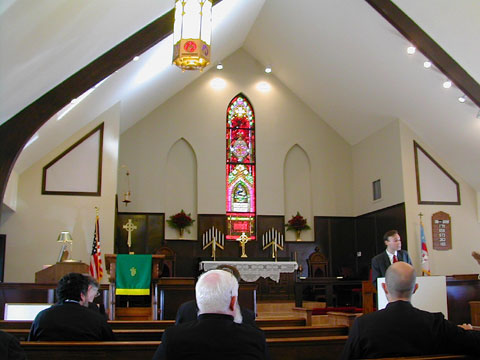
A gathering of clergy in Houston this last week was a wonderful time to see old friends, make new ones, and see the new Cathedral of the Diocese of Mid-America.


The Cathedral. The window was commissioned in the late 1800's and gifted to the cathedral from one of the oldest parishes in the diocese. The bottom pane contains a censor with the smoke from the incense ascending upwards through an Alpah and Omega to the diadem above. So our prayers ascend through the Son to the Father.


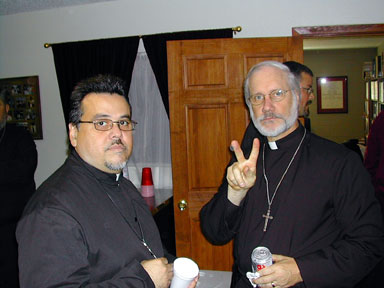
Old friends, Father John and Father Scott.


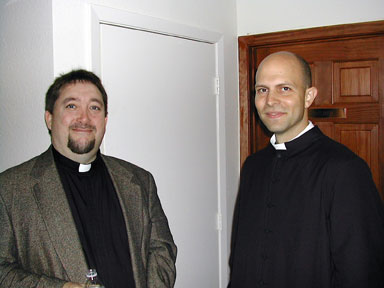
New friends, Mike, who will have his orders regularized soon and Father Rusty, priest in Houston.

Sunday, October 15, 2006

From the Mouth of Babes

My son is studying to be confirmed by his bishop at the end of the month.  He is a youngest of a group of young confirmands, and I am proud of them all.

Of course, they don't always talk the way we might think they should talk about God.  But conversation with them about God is always enjoyable and often quite rewarding as I learn more about my faith from them.

One of my young confirmands had a hard time grasping the meaning of being gifted with the Holy Ghost at his baptism.  He was probably four or five and he asked:  "Is the Holy Ghost heavy?   Will I still be able to jump if I get the Holy Ghost?"

Of course, those questions are awfully good at reminding me of how very little I know.  My son helped me in that category the other night as we were talking our way through the Apostle's Creed.  

We were talking of Jesus being born of the Virgin Mary (after some discussion of the theotokos, we had to discuss the two natures of Jesus so that he could understand how Mary did not, indeed, exist before God) and of how he grew up into a little boy, like my son, and how he must have played and fallen down and done so many things that boys do.

As we were discussing how very real and human Jesus was in the terms that my son tends to understand, he popped off with:

"Dad, I just really have a problem with that guy."

Of course, my eyebrows raised and I asked which "guy" he was referring to.  

"Jesus, Dad, I just really have a problem with that guy."

"And what problem do you have, son?"

"Well," he began, in his five-year-old voice, "How can he know everything???"

I decided that that was a very good question indeed and saved the rest of the discussion for a later time when, perhaps, my mind might be as sharp, as full of wonder, and as inquisitive as my son's and his fellow confirmands'. 

Thursday, September 14, 2006

Aidan's First Day of School


My son has attended school since he was a newborn, but this is the first time that he's actually a student at St. Andrew's Academy! Not a bad start--only had to see the headmaster once....

Saturday, September 02, 2006

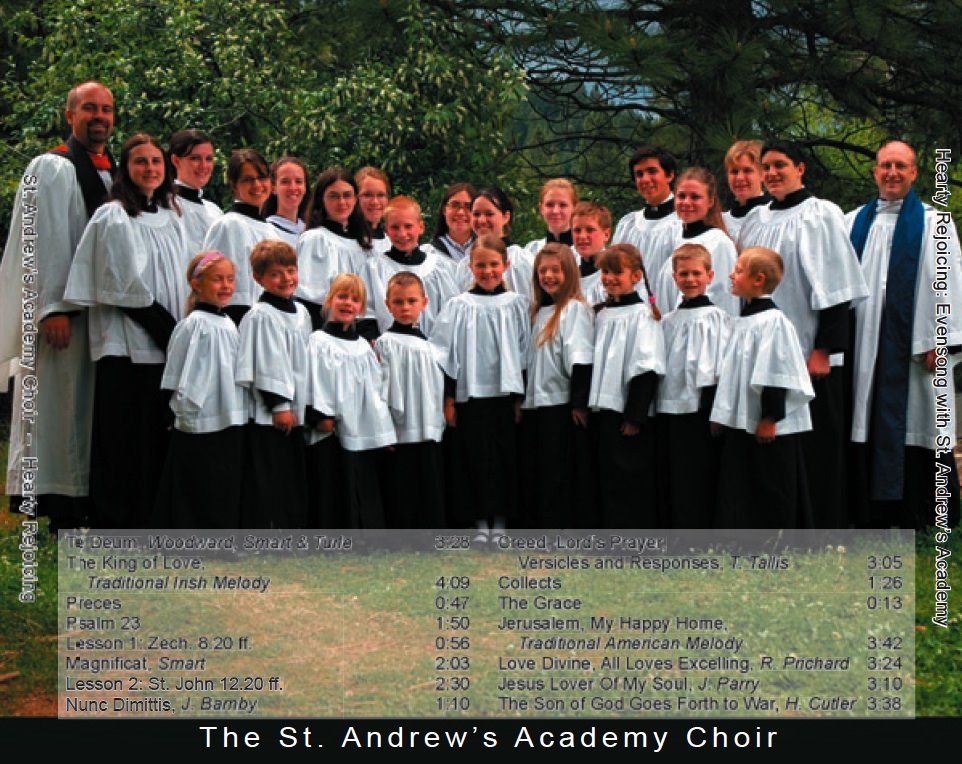
St. Andrew's Academy Choir Chanting the Te Deum


In place of a thoughtful post, I give you the Te Deum--much more thoughtful than anything I could come up with....

This is a cut off the St. Andrew's CD for Spring, 2006 (cover of the CD above).

Photo Sharing - Upload Video - Video Sharing


Sunday, July 09, 2006

The Doctrine of the Real Presence of Christ in the Holy Eucharist from the Anglican perspective

A friend of mine, Father Derrick Hassert, has written the following on the the doctrine mentioned in the title. Any thoughts, comments, questions, snide remarks?

As Anglicans I believe we must first go to the Scriptures, where we are told by St. Paul that the “. . .Lord Jesus, the same night in which He was betrayed, took bread; and when He had given thanks, He broke it and said, ‘Take, eat; this is My body which is broken for you: this do in remembrance of Me.’ In the same manner also He took the cup when He had supped, saying, ‘This cup is the new testament in My blood: this do ye, as oft as ye drink it, in remembrance of Me.’ For as often as ye eat this bread and drink this cup, ye do show the Lord's death until He come. Therefore whosoever shall eat this bread and drink this cup of the Lord unworthily, shall be guilty of the body and blood of the Lord. But let a man examine himself, and then let him eat of that bread and drink of that cup. For he that eateth and drinketh unworthily, eateth and drinketh damnation to himself, not discerning the Lord's body” (1 Cor 11: 23-29).

Similarly, St. Paul declares to us that “The cup of blessing which we bless: is it not the communion of the blood of Christ? The bread which we break: is it not the communion of the body of Christ? For we, being many, are one bread and one body, for we are all partakers of that one Bread” (1 Cor 10: 16-17). The writings of the Church Fathers, especially the Apostolic Fathers, declare likewise without any great philosophical speculation. The truth of Christ’s words, and the words of St. Paul, are accepted through faith.

When we turn to the formularies of classical Anglicanism (the 1549-1928 Prayer Books, the Articles, and the homilies) what are we told about the Eucharist? We are told that it is an “outward and visible sign of an inward and spiritual grace” the outward part being bread and wine and the inward part being Christ’s Body and Blood. The Articles declare likewise that the “The Body of Christ is given, taken, and eaten, in the Supper, only after an heavenly and spiritual manner.” In the homilies we read of “the due receiving of the blessed Body and Blood of our Saviour Christ under the form of bread and wine.”

Here, in the classical Anglican documents, we have a very Scriptural teaching which conforms as well to the teachings of the Church Fathers. Some wish to press beyond these points of agreement and engage in all manner of scholastic inquiry…. Some will ask the manner of Christ’s Presence in the Sacrament? Is it bodily, physical, carnal, corporal, localized?


Though some may hold to various viewpoints that are more specific than that outlined above by Father Hassert, many would argue that they are not to be pushed on the Church for belief because they cannot be proved by and from Scripture. Many would also argue that the basic Scriptural basis of Anglicanism is also one of its greatest strengths.