We'll hold a funeral service this next week for my dear parishioner. We'll commune with him tomorrow around the table of our Lord. At the funeral, we'll pray for him. Tomorrow, we'll praise God with him.
For many who live, ecclesiastically, where I lived in years past, this all sounds strange--very strange. The person's dead. Why would you pray for him? What do you mean we'll praise God with him? commune with him?
Our protestant limitations in American Christianity (at least in the protestant sections--actually, probably in much of the catholic sections too) really do us no favors in understanding the Church of Jesus Christ. Broadly speaking, it tends to be thought of as all those who have accepted Jesus into their heart. That, of course, is just not the definition given in the Holy Scriptures. The Church is all those who are "in" Jesus (whether they remember saying the sinner's prayer is really besides the point). This getting into Jesus is by grace through faith and the operation of the Holy Ghost through Word and Sacrament (all that to say that I won't be getting into this stuff, I'm not trying to argue soteriology here).
If we remember that "all" those in Christ are in his Church, then we realize that when we worship with the whole Church, we worship with those that have gone before. Thus, we commune with our departed brother tomorrow at Christ's table, where all the Church communes.
Why do we pray for those who have gone before? Because our prayers do not just have to do with earthly things. We often pray for spiritual growth in Christ for each other here on earth. Why do we presume that such growth ceases to happen because we are departed from our bodies? Being without our bodies may mean that we are free of the temptations of the world, the flesh and the devil, but it doesn't mean that we have nothing else to learn. Unless we are like God when we die, which the Holy Scriptures seem to oppose, we still have much to learn. After all, Adam and Eve prior to the fall had much to learn--and they were without sin.
So, we pray for our brother at his funeral this week and thereafter. After all, he is a member of Christ's Church, and we are to pray for the Church--both here on earth and in the heavenlies.
Saturday, February 18, 2006


Saturday, February 04, 2006
Re-calibration
I have a dear parishioner who is at home dying. He and his wife are so wonderfully kind and generous to me as I visit them, and I am moved by the seriousness and piety with which they take their faith and spiritual lives.
This sort of situation is not uncommon in the life of a parish priest, I'm afraid. In a healthy parish of some average size, a parish priest is not dealing with this every day, but it comes up periodically. At the recent clericus, one priest mentioned that his parish had been an older parish and in the last dozen or so years, he had buried 90 of Christ's faithful. Wow.
So, I am ministering, to the best of my ability, to this older couple. I bring them the sacrament, pray with them, give them the parish news. The parish can ill afford to lose either one of them, as we don't have that many older people in the parish--well, they're essentially it.
As to the title of this post. Much happens in life that is so trivial and inconsequential. So much happens that is just stupid and insipid and tediously taxing to one's patience. In one sense, because of our laziness and slackness, much just doesn't happen at all.
So many people spend their life complaining--and I point the finger at myself too for such silliness and pettiness. Yet, when I am faced with the death of a wonderful member of our parish, when I meet with a student who has just lost her father, when I see the brokenness all around me, but particularly, death, I have my meter recalibrated.
It's the sort of meter that would flash or buzz when you enter an outhouse. It's the sort of meter that everyone really needs to have and keep calibrated. For me, death up close and personal does a very fine job of recalibrating it. Suddenly the world and life and the universe is all put into perspective, I'm reminded that we only have one ride on this merry-go-round, and each moment is particularly precious and important to the Kingdom of God and to the joyous life I am supposed to live in Him.
So, when I hear the incessant complaining and carping, when I hear how rough it is in this situation or that--and particularly when I come up with those issues from my own heart, I am reminded of the young death of my best friend from childhood, of the young death of two friends and mothers (one a parishioner) on Christmas Eve's two years apart, I'm reminded of the accident this last Christmas time of a family friend who lived through his own car accident only to be killed by the car coming behind him, I'm reminded of my dear parishioner and his wife who is not ready to say goodbye, who spend their days together comforting one another, laughing a little, crying a little and probably just being quiet together as a married couple learns how to be after dozens of years of marriage.
I hope and pray that I am patient and kind and loving to those who are complaining, but I hope to God that I can communicate the important things of life to them too--especially when I am the one complaining. We only go round once; let's live each moment in the joy of our Lord and quit complaining about the great blessings that He has seen fit to bestow upon us--even the blessings of trials and temptations since we know that they are meant for our continual sanctification as well.
And, may God continue to give me opportunities to re-calibrate that all important meter in His timing and will.
Wednesday, February 01, 2006

The Carmelite Monastary in Napa Valley. Father Brad (first collage, top right) and I made it in time for the start of the Clericus, and I went ahead and stole all these pictures from his camera. Nice photo's, Father!

The Clericus gatherered 17 bishops, priests and deacons on the lovely grounds of the monastary right next door to the Mondavi Winery, whose vines are pictured below (about 80 years old).

Tuesday, January 31, 2006
Picture Snapping on a Winter's Day
The sleepy hamlet of Chester on a calm morning.

Father Brad and myself were on our way to a clericus (meeting of clergy) and he wanted to get some shots to email his wife and kids. Thus, these pictures.



And, of course, we need a picture of the cleric himself, just to prove he was here.
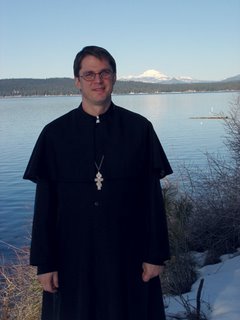

Father Brad and myself were on our way to a clericus (meeting of clergy) and he wanted to get some shots to email his wife and kids. Thus, these pictures.


And, of course, we need a picture of the cleric himself, just to prove he was here.

Sunday, December 25, 2005
Christmas Lived
My sermon this noon was probably not terribly coherent, as I hadn't had much sleep since Midnight Mass the morning before. Yet, I am always intrigued this time of year by Lancelot Andrewes' Christmas sermons and his emphasis on Christ made manifest to us through bread and wine in the Eucharist, just as He was made manifest to the shepherds and eventually to the wise men while He was in Bethlehem.
My text was out of Matthew, chapter two, and I was caught by the simple plan of the wise men and the simple action of the wise men when they arrived. They told Herod that they wanted to find the King of the Jews and worship him. Indeed, when they arrived, that's exactly what they did, falling to the ground and eventually giving an oblation--gifts of gold, frankincense and myrrh.
There have been more than a few Christmases, when I've been under the weather, tired and worn out, lazy--sipping my hot chocolate in my sister's comfortable couch, family all around--when I didn't really feel like getting down to the Church and celebrating the Eucharist. Yet, each time, I hauled myself up and out and down to the Church--and each time, I recognized that I was exactly where God wanted me. I was doing exactly what the wise men did on that first Christmas, and I could hardly find a better example than the first Gentiles to meet Jesus.
So, I reflect again on the basic and simple nature of God's calling to His children:
Come and worship, come and worship, worship Christ, the new born King.
It's that simple. That's the foundation of our lives. As we pass this glorious Christmastide in revelry and feasting, as we ought, we should also remember that the foundation of that revelry and feasting is the worship of our King. That's Christmas lived.
Thursday, December 22, 2005
Christmas Joy
Please take a moment to read this article from Touchstone Magazine on the subject of Christmas and joy--especially if you need to smile!
Tuesday, December 20, 2005
If no one but the minister is present...is it still Church?
Many of you have heard the NPR report on Mega Churches closing their doors on Christmas Sunday this year. Perhaps you have read the AP article I did (I don't know how long the url will be good, as the link I first read it off of, Yahoo, has expired).
I had actually been predicting such a move by the "Mega Church" movement--although, I have to admit, I didn't really think it would happen; I was just extending the presuppositions that the mega church movement rests upon to their logical conclusions.
You see, I always get asked, each year by someone, why in the world we are holding worship services on Christmas day. I usually remark that we call it "Christ's Mass" for a reason. It is one of the high holy days of the Christian year--it is the celebration of the incarnation of the second person of the Trinity, after all--a not too unimportant event in the history of salvation. The Church has always worshipped God for the incarnation of the Son. Why would we not do so on the day that we celebrate that incarnation?
Of course, I hear a reply about family and friends and worshipping with the family and opening presents and not enough time in a day, etc.
So, considering that so many of my evangelical friends do not worship on Christmas day, I concluded that many of the same pragmatic reasons would be brought to bear this year, when Christmas falls on a Sunday. Of course, I was still surprised when I read the article and heard the NPR report.
Of course, the amazing thing is the clarity of the presuppositions. There is no doubt that pragmatism, or utilitarianism is at the bottom of it. “Whatever works” is the motto of the day.
“The last time Christmas fell on a Sunday was 1994, and only a small number of people showed up to pray…” (AP article). Well, if only a small number come to Church, we ought to cancel it, after all, it wouldn’t look good for the Church to be empty. Rather tell the world we don’t think worshipping God is important than admit that a few do.
"If our target and our mission is to reach the unchurched, basically the people who don't go to church, how likely is it that they'll be going to church on Christmas morning?" (ibid.).
"If we weren't having services at all, I would probably tend to feel that we were too accommodating to the secular viewpoint, but we're having multiple services on Saturday and an additional service Friday night…. We believe that you worship every day of the week, not just on a weekend, and you don't have to be in a church building to worship” (ibid.).
Well, the Church of all ages would agree that one should worship every day of the week. That has always meant, however, getting on one’s knees and actually praying! And no, one doesn't have to be in a church building--but if such a building is available, why wouldn't it be used?
Whatever works is the key to the equation for much of this reasoning. We have less people on a Sunday that is also Christmas and the name of the game is numbers, so we’d better just call it off, because there is nothing more to be aimed at, apparently.
Some of the quotes from the NPR piece bring out more of the problem. From Willow Creek Community Church we understand that "Officials are handing out a DVD for families to watch together."
DVD’s may be nice (or not, but that’s another topic), but what does that have to do with worshipping God in His Church? Yes, yes, I know, the Church is not the building. But neither is it the family all gathered around the vidiot box. The worship of the Church is the assembly of the saints for the purpose of adoration, praise, thanksgiving, oblation and communion with our God. You don’t do that by yourself, generally (unless you're the only one who showed up to worship), or with your family in front of the TV sipping on a hot cocoa.
Steve Williams, a volunteer at Northpoint Community Church in Atlanta says that closing the Church will not take anything away from Christmas "for us because we will celebrate his birth...whether we're at home, or at another Church...or with family or whatever, we will celebrate Christ's birth” (NPR).
I think the key word here is “whatever.” That seems to be functional word for the Mega Church movement. Whatever works. Whatever gets people into the pews (or stadium seating, or “whatever”). Whatever gets people to be emotionally connected. Whatever gets them to love Jesus. The list could go on of course.
Somehow, the “whatever” mentality doesn’t seem to jive with the Words of Jesus, who doesn’t say whatever works, but pick up your cross and follow me. Christ was not a pragmatic kind of guy; rather, He was speaking of incredible visions for His people, of justice and love and mercy and doing the impossible--literally, like rising from the dead.
Jesus calls us to himself. He calls us to himself in worship, where we commune with Him at His table. It doesn’t matter if there are two people or two thousand people. The call is the same and our response is to be the same.
If that is indeed our calling, then we can never shut the doors of the Church on a Sunday, the ancient and Biblical day of worship for the Church. Nor should we allow utilitarian thinking to keep us away from worshipping our Triune God on a high holy day like Christmas, even if it is not on a Sunday.
And from the quotables section from World Magazine, December 17th issue:
"This speaks to the dilapidated state of evangelical faith today."
David Wells, professor of theology at Gordon-Conwell Theological Seminary in Boston, on many large evangelical churches canceling worship services on Dec. 25, a Sunday this year, so that people will spend more time with their families on Christmas.
Friday, December 16, 2005
'tis the Season
It is the Season of Christmas, most of our world would say. Why, you ask, would they say that? Well, of course, because our society is conditioned to say that. And it is conditioned, interestingly enough, by the marketing of everything. In other words, our entire culture seems to be led by the world of marketing and consumerism. We know that it is the Christmas season precisely because the stores have their Christmas stuff up (after all, Thanksgiving was weeks ago), and the lights are up on every neighbor's house.
Now, I'm not a "bah, humbug" type of person in general, but in my meager attempt to keep Christmas confined to the proper season and not to lose Advent, I do not go in for this Christmas hype. There are no Christmas carols playing on the stereo at my house. There is no Christmas tree standing in my living room. There are no Christmas parties happening at my place this next week.
Now, you think, that sure sounds like he's a grinch. What about his poor children, his poor wife? In reality, I'm just waiting to celebrate Christmas when it is time. Our tree doesn't usually go up actually on Christmas Eve’, but mostly that's just pragmatic. So much is going on Christmas Eve' that we would never get it up--so it goes up either during that day, or perhaps a day before or so. Perfect world, though?? Christmas Eve.
Also on Christmas Eve': Out come the Christmas CD's, the decorations, the crèche, etc. Why? Because I'm tired of having my religious traditions defined for me by Wal-Mart and Target. Christmastide is the twelve days of Christmas--beginning on Christmas, not on Thanksgiving!
I suppose the song, "The Twelve Days of Christmas" doesn't get sung anymore, but surely kids these days who do hear it are asking: "Twelve days of Christmas?? What's that?" Or perhaps it's "Oh, that must be the 12 days of after Christmas Sales that go on."
Oh, and let's not forget that after Christmastide (during which all manner of Christmas parties should be hosted and attended and carols sung and listened to) comes Epiphany--the Manifestation of Christ to the Gentiles. Of course, our modern culture has co-opted that holy day too. "We Three Kings of Orient Are" is sung on Christmas Eve' when everyone knows that the wise men came later. January sixth is the celebration of the wise men's visit to the Christ Child--Christ being made manifest to the Gentiles, whom are represented by the wise men. This is the event from which we get the tradition of gift-giving--but of course, we have to shove everything into one crazy day.
The Christmas tree comes down on Epiphany, but usually, in our culture, it's been down for a week before that and Christmas is forgotten in the rush to celebrate New Year's--which, by the way, is the Holy Day known as The Circumcision of Christ.
So, I suppose that I'm one of the very few who will continue to try to hold out against the forces of Marketing and Advertising and celebrate the Church seasons the way the Church set them up and not corporate America. I'll continue to get strange looks and have to explain a lot to my children. But, one never knows...perhaps my children will understand that Santa Claus was a great bishop of Christ's Church who cared more for others than he did for himself and was known for continuous and selfless giving to the poor as well as strong doctrinal integrity. That's better--any day of the week--than Santa as the great cosmic wish giver from the North Pole who graces every department store and every shop window in the nation as we celebrate the incarnation of the God/Man who came that He might die.
Subscribe to:
Posts (Atom)